The NEUROMECH Consortium


Università degli Studi dell’Aquila
The University of L’Aquila stands as a prominent public institution dedicated to both teaching and cutting-edge research. Housing 7 Departments, the university boasts an extensive academic portfolio, offering its 19,000 enrolled students 68-degree courses 30 Bachelor of Science Programs, 31 Master of Science Programs, 4 Single-Cycle Degrees (including 10 international Double/Multiple Degrees), 4 Erasmus Mundus Master Degrees, and 10 PhD schools. Notably, the institution conducts teaching in English across several programs, fostering an internationally inclusive learning environment.

Pier Giorgio Mastroberardino
Pier G. Mastroberardino is an Associate Professor at the University of L’Aquila, Italy and a Principal Investigator at the Erasmus MC. He has expertise in neurobiology and mechanisms of neurodegeneration; focus on metabolism, mitochondrial biology, and DNA damage and repair in the nervous system; expertise in modelling neurodegenerative diseases in rodent models; expertise in supervising postdoctoral fellows, PhD student, and technicians.

Dr. Chiara Milanese
Dr. Mariano Catanesi
Prof. Elisabetta Benedetti

Prof. Maria Grazia Cifone

Dr. Martina Sette

Consiglio Nazionale delle Ricerche – Istituto di Genetica Molecolare
The Institute of Molecular Genetics (IGM) “Luigi Luca Cavalli-Sforza” of the Italian National Research Council (CNR) is a multidisciplinary research center dedicated to understanding normal and pathological cell functions through a systemic approach. The institute’s mission focuses on elucidating the molecular mechanisms underlying diverse pathological conditions, including cancer, premature aging, genetic diseases, and viral infections. By studying genome alterations and their impact on cellular metabolism and intercellular coordination, IGM aims to generate knowledge that can translate into innovative therapies.
IGM researchers integrate diverse expertise in biochemistry, molecular and cellular biology, genetics, and bioinformatics. Their work adheres to the philosophy of “from cell to pathology,” focusing on the flow of genetic information from DNA to proteins and its pathological deviations. This approach underpins their commitment to improving healthcare and promoting societal well-being.
The institute’s main facility is located in Pavia, with units in Bologna and Chieti, and maintains strong educational ties with the Universities of Pavia and Bologna. IGM hosts approximately 80 students and fellows annually across its research programs. Its advanced facilities include state-of-the-art laboratories for molecular biology, cellular imaging, bioinformatics, and genomic analysis, supporting both basic and translational research, , with a focus on understanding and addressing genomic instability in diseases like cancer and neurodegeneration.

Marco Foiani
Marco Foiani is the Director of CNR and professor of molecular biology at the University of Milan, Italy. Prof. Foiani’s major contributions are within the fields of chromosome dynamics and genome integrity.
His work has contributed to elucidate the ATR and ATM-dependent checkpoint processes controlling the interfaces between DNA replication, recombination, transcription and DNA topology and preventing abnormal chromosome transitions. He has deep expertise in supervising postdoctoral fellows, PhD student and technicians.

Giulia Bastianello

Johannes Gutenberg University Mainz
Currently, some 30,000 students from over 120 nations study at JGU (www.uni-mainz.de). JGU has a strong research focus and regularly achieves solid positions in international research rankings. An important attribute of JGU is its research-oriented teaching – which incorporates research-based topics in the curricula early on. JGU endorses the European Charter for Researchers and the Code of Conduct for the Recruitment of Researchers and is dedicated to their full application by implementing its HR Strategy for Researchers. The Welcome Center for visiting scholars and students provides support for all contractual, insurance, visa and accommodation issues.An important attribute is its research-oriented teaching, which incorporates research-based topics in the curricula early on. The Faculty of Biology is housed in two brand-new buildings (Biocenter I, finished in 2018, and Biocenter II, finished in 2020), providing excellent research and training infrastructure.
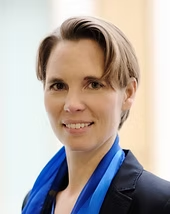
Dorothee Dormann
Dorothee Dormann is a Full Professor at Johannes Gutenberg University (JGU) and Adjunct Director at the Institute of Molecular Biology (IMB) Mainz, Germany. Her research focuses on the molecular mechanisms of RNA-binding protein dysfunction in neurodegenerative diseases, particularly in Amyotrophic Lateral Sclerosis (ALS) and Frontotemporal Dementia (FTD). Dorothee Dormann currently supervises two postdocs, five PhD students in structured PhD programmes, and a technician. In the past, she has promoted four PhD students, three MSc students and has been a thesis advisor to >dozen external PhD students.

Saskia Hutten

Erasmus Universitair Medisch Centrum Rotterdam
Erasmus University Medical Center (Erasmus MC) is one of Europe’s leading university medical centers, integrating world-class biomedical research with clinical care and education. Located in Rotterdam, The Netherlands, Erasmus MC has an annual research budget of approximately €120 million and extensive expertise spanning fundamental, translational and clinical research. The institution is internationally recognized for its excellence in medical research and is among Europe’s most successful participants in EU-funded collaborative projects.
Within Erasmus MC, the Department of Molecular Genetics is internationally
renowned for pioneering research on genome stability, DNA damage responses, cancer and aging, providing a highly multidisciplinary environment that bridges fundamental biology with translational medicine.
Jurgen Marteijn leads the Transcription Stress and Genome Stability Laboratory at Erasmus MC and is a Principal Investigator at the Oncode Institute. His research aims to understand how DNA damage and transcription stress threaten genome stability and drive aging and neurodegenerative disease. By combining advanced live-cell imaging, CRISPR genome engineering and quantitative cell biology, his group studies the molecular mechanisms that preserve transcriptional integrity in human cells.
The laboratory has identified several key components of the transcription-coupled DNA repair pathway, including UVSSA, ELOF1, STK19 and HLTF, and recently discovered a novel transcription-coupled DNA-protein crosslink repair pathway. Within NEUROMECH, the Marteijn lab will investigate how mechanical stress affects transcription-coupled DNA repair and transcription stress in differentiated human neurons, providing fundamental insights into neuronal vulnerability during aging and neurodegeneration.

Jurgen Marteijn
Prof. Dr. Jurgen Marteijn is a Full Professor of Transcription Stress and the DNA Damage Response at Erasmus MC, with over 10 years of PI experience and a strong track record in coordinating interdisciplinary research.
He is Vice Chair of the Molecular Genetics Department and has successfully supervised 11 PhD projects.
Prof. Marteijn chairs the Life Sciences Roundtable of the Dutch Research Council (NWO), is a recipient of the prestigious ERC advanced and Veni, Vidi, and Vici grants of the Dutch research council, and is a partner of the ONCODE Institute, a leading virtual cancer research consortium.

Maria Tresini

University College London
University College London (UCL), part of the University of London, stands as a leading public research university in London, England. Established in 1826 with an ethos of inclusivity. Comprising 11 faculties housing over 100 departments and research centers, UCL maintains an extensive academic presence and operates renowned museums and collections. Financially robust, it contributes significantly to the UK economy, primarily through research impact and institutional spending.
Recognized as part of prestigious academic networks like the Russell Group and the League of European Research Universities, UCL is esteemed for its role in the “golden triangle” of research-focused institutions in southeastern England.
Engaged in various publishing and commercial activities, UCL fosters innovation and academic entrepreneurship. Its alumni list boasts remarkable individuals, including the founder of Mauritius, Japan’s first Prime Minister, and notable figures in science and music. UCL’s academic legacy shines through discoveries in scientific realms, boasting affiliations with numerous Nobel Prize winners and Fields medalists.

Tammaryn Lashley
Tammaryn Lashley is Professor of Neuroscience at University College London’s Queen Square Institute of Neurology, Deputy Head of the Department of Neurodegenerative Disease and Departmental Graduate Tutor for the Institute. She is also a former President of the British Neuropathological Society. She has extensive expertise in the neuropathology of neurodegenerative diseases, including Alzheimer’s disease, Parkinson’s disease and the heterogeneous group of frontotemporal dementias. Her research includes the detailed characterisation of disease-associated pathologies, the role of heterogeneous nuclear ribonucleoproteins (hnRNPs) in disease pathogenesis, the contribution of glial cells to neurodegeneration and the involvement of DNA damage in frontotemporal dementia. For more than 25 years, Tammaryn has worked with post-mortem human brain tissue generously donated by individuals and their families to brain banks in the UK and internationally. This tissue provides an invaluable resource for understanding the cellular and molecular mechanisms underlying neurodegenerative diseases. Tammaryn currently leads a research team comprising four postdoctoral researchers, two PhD students and five MSc students. She has supervised 17 PhD students to successful completion, and more than 25 MSc students have undertaken research projects within her laboratory.

Institut National de la Sante et de la Recherche Medicale
The LVTS (Laboratory of Vascular Translational Science, INSERM, U1148) is a large research unit (>300 people) working on various aspects of vascular pathologies, from molecular and cellular properties up to clinical imaging via MRI and PET. Team 4 aims the development of imaging technologies as diagnostic surrogate markers in health and disease. The purpose is to provide early detection and location of the biological process involved in tissue degeneration, and to follow in situ the therapeutic activity of new compounds targeting localized tissue specific diseases. After moving from morphological to functional approaches, the new challenge is to shift to molecular imaging, providing evidence of specific molecular, cellular and tissue localization targeting. Molecular imaging is a high standard tool for translating biological molecular knowledge into clinical applications for all fields of human tissue pathologies. Specific molecular imaging requires developing innovative ligands identified through biological and/or chemical approaches, and transversal multidisciplinary competencies and know-how: chemistry, pathophysiology, animal experimental model validation, pharmacology, imaging, biophysics, radiopharmacology, software. Imaging specialists must be closely associated to the research of such imaging ligands because the development of clinical applications is the final goal. The Unit is offering such a multidisciplinary collaboration, and national or international collaborations help us in some fields were some competencies are lacking, such as signal quantification or PET chemistry.

Ralph Sinkus
Ralph Sinkus is Research Director CNRS and Chair in Biomedical Engineering at King’s College London. He is PI and has a profound expertise in biomechanics and its non-invasive quantification via MRI. He has numerous publications in the domains of liver fibrosis and inflammation quantification via biomechanics, tumour mechanics, neuro-mechanics, and wave propagation in complex media. He supervised several PhD students and Master students.

Prof. Valérie Paradis

Organo Therapeutics
OrganoTherapeutics (OT) has the mission to accelerate the development of therapeutics against neurodegeneration. The current focus of OT is on Parkinson’s disease (PD). The OT team is convinced that therapeutics targeting complex human disease like PD, need to be developed with complex human patient specific models; a precision medicine approach, fully embracing the 4P Medicine concept (Predictive, Personalized, Preventive and Participatory) is necessary to tackle the major healthcare burden that originates from the demographic shift of our societies and there thereof resulting increase in neurodegenerative disorders.
In order to achieve this the OT team has developed PD patient specific cell culture models, organoids and assembloids, that replicate the PD pathology faithfully and to an extend that cannot be found in any other cell culture or animal model. The organoid and assembloids models are IP protected and have been used in the past 4 years in joint projects with academic and industry partners from Europe, USA and Japan.

Jens Schwamborn
Jens Schwamborn is co-founder of OrganoTherapeutics SARL. Additionally, he has an affiliation at the University of Luxembourg / Luxembourg Centre for Systems Biomedicine. This affiliation will facilitate the awarding of a PhD title to the candidate selected in this program . While OT focuses on the usage of brain organoid models for in vitro modelling of ND and testing of potential therapeutics, his academic lab focuses on understanding the mechanisms underlying neurodegeneration, with a particular focus on Parkinson’s disease. Jens Schwamborn has successfully supervised more than 15 PhD students as well as various postdocs and Master students. He has experience as PI in several Horizon 2020 projects, including e.g. SysMedPD, CONNECT and NAP. Through the university affiliation he also has extensive teaching experience including classes on Molecular Medicine and Advanced Cell Biology.

Isabel Rosety

Single-cell technologies
Single-cell technologies Ltd. is a Hungarian-owned micro-enterprise, whose main activity is information technology consulting and related software development, sales and distribution in the era of health and clinical applications.
Dr. Péter Horváth, an internationally renowned researcher, after returning from Switzerland, took over the applicant company together with his business partners, whose main goal is to develop computer algorithms for solving biological problems. The research of Single-Cell Technologies Ltd. focuses on the frontiers of computer science, cancer research and omics – using a combination of experimental laboratory, light microscopy, computer vision and machine learning methods. The company’s experts are working on interdisciplinary projects to automatically recognise and describe the morphology of cells in cell lines, primary human samples and tissue sections. To achieve this, they combine 2 and 3D microscopy with next-generation image analysis and artificial intelligence methods.

Dr. PEter HorvAth
Peter Horvath (CEO, Single Cell Technologies Ltd.; Director, Biological Research Centre, Szeged, Hungary; Group Leader, Institute of Molecular Medicine, FIMM-EMBL, Finland) specializes in AI and machine learning- driven single cell analysis, integrating genomics and proteomics. His research focuses on computational solutions for single cell biology, combining wet-lab, microscopy, and image analysis. He currently supervises 5 PostDocs, 6 PhD students, and 5 MSc students, with his former students achieving notable success, including high-impact publications in Nature Methods, Nature Communications, and Cell Systems.

András Kriston

Ferenc Kovács

Paul Scherrer Institut Villigen, ETH Zurich
The Paul Scherrer Institute (PSI) is the largest research institute for natural and engineering sciences in Switzerland and is integral part of the ETH Domain, alongside ETH Zurich, EPFL Lausanne, Eawag (Swiss Federal Institute of Aquatic Science and Technology), Empa (Swiss Federal Laboratories for Materials Science & Technology), and WSL (Swiss Federal Institute for Forest, Snow, and Landscape Research). PSI leads groundbreaking explorations across four key domains: future technologies, energy and climate studies, health innovation, and fundamental aspects of nature. At PSI, the development, construction, and operation of sophisticated, large-scale research facilities are paramount.
Situated in the Canton of Aargau, PSI spans the municipal areas of Villigen and Würenlingen, gracing both banks of the River Aare with its cutting-edge research facilities.

G.V. Shivashankar
Shiva Shivashankar is a Full Professor at ETH Zurich jointly with Paul Scherrer Institute, Switzerland. His laboratory studies the nuclear mechanobiology of cellular ageing and rejuvenation and develops digital mechano- genomic biomarkers for ageing related diseases including cancer and neurodegeneration. His laboratory is committed to training the next generation of scholars. A large number of undergraduate, PhD and postdoctoral scientists (more than hundred) have carried out research in his laboratory. In particular, he has trained twenty PhD students and three PhD students who are currently enrolled in his laboratory. He has also been a joint PhD supervisor for an additional four PhD students. Most of his laboratory alumni have outstanding fellowships and faculty positions around the world.

Dr. Anita Goyala

Maryam Moazeni
Associates

The Blackboard Tree

Mariapia Di Palma

Università Commerciale Luigi Bocconi

Simone Ghislandi

Université du Luxembourg

Jens Schwamborn

Université Paris Cité
Elisabeth Hombrados

University of Szeged

Marta Szell

Friedrich Schiller University Jena

Katharina Schregel